Before you install solar panels
Checklist
Before buying anything, the following checklist will help you decide what is best for you.
-
To see questions and answers from other solar panel owners or to post your own questions, join r/solar on Reddit.
-
Think about where you might want to mount solar panels.
-
Learn from our mistakes.
-
Ask many questions to as many solar panel providers you can.
-
Get price quotes from at least three different solar panel providers.
-
Check for Rebates to see what you qualify for.
-
Check the Prerequisites to prepare your house for solar panel installation.
-
Raise your highest bill to allow for more panels installed.
Decide where to mount
How many solar panels you need depends on:
- The size of your panels (200 - 425 kW)
- Your home's energy usage (kWh)
- Where you'll mount your solar panels
| Mounted on | Advantages | Disadvantages |
|---|---|---|
| Ground (or DAT) | - Easier to remove snow, clean, and maintain - Isn't affected by roof age or repairs - Better airflow keeps them cooler and more efficient - No need to pay $7k - $9k when re-roofing - Infinitely safer than climbing/walking on a roof - DAT produces 50% more power throughout the year | - Needs space in your backyard - 10-20% more expensive to install - Hard to find an installer |
| Rooftop | Has the most installers | - Difficult to clean or maintain - Costs $7k - 9k to remove/reinstall |
| Carport | - Easier to clean and maintain - Isn't affected by roof repairs or replacement - Protects driveway vehicles | Need to build a structure over your driveway |
| Balcony | - Easy to install yourself - Costs only $385 - $500 | - Smaller than rooftop installs - Produces 10% of rooftop installs |
Ground-mounted
Rooftop panels are the most common, but non-rooftop panels are cheaper in the long-run because:
- You won't need to pay $7,000 - 9,000 to remove and reinstall when fixing or updating your roof.
- You won't need to climb onto your roof for cleaning or maintaining any issue with your panels.
| Dual-Axis Tracking (DAT) panels | |
|---|---|
| If you have a backyard that would allow Dual-Axis Tracking (DAT) panels, then each panel will produce ~50% more than being on a rooftop since these move with the sun: - East-to-west during the day - Flat-to-steep with the seasons For example, twenty-four 200-watt (4.8 kW) DAT panels produce about the same as eighteen 400-watt (7.2 kW) rooftop panels. | 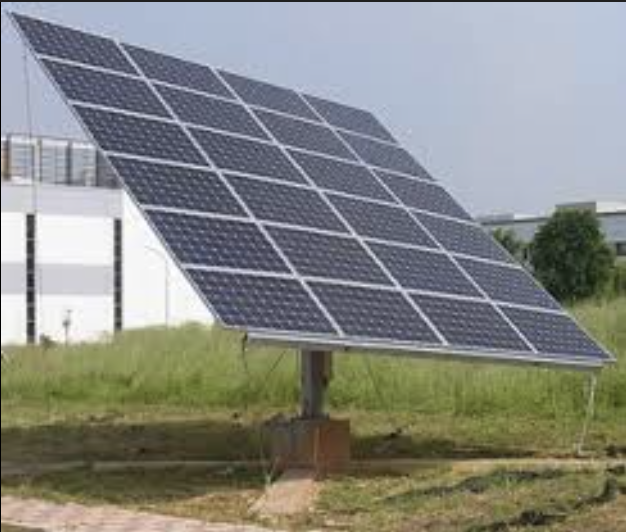 |
Rooftop-mounted
Solar installers calculate your needed number of rooftop panels based on the kWh used on your last 12 months of electric bills; but I think using the highest bill multiplied by 12 is a safer calculation to cover your heaviest usage month and for future-proofing your solar panel system.
| Method | Calculation | Example |
|---|---|---|
| 12 month's of kWh used | (__ kWh) / (400-watt panels) = Panels | 8000 / 400 = 20 panels (8.0 kW) |
| Highest month's kWh x 12 | (__ kwH) / (400-watt panels) * 12 = Panels | 800 / 400 * 12 = 24 panels (9.6 kW) |
Note: This example uses our numbers, and we wish we had installed 24 panels instead of only 20. We're stuck with 20 since no installer wants to bother with a tiny $600 job ($200 profit) of installing 4 panels compared to installing $18,000 systems.
Keep in mind: | |
|---|---|
| - Winter kWh usage is about twice as much as summer kWh usage. - Winter months produce about one-third as much electricity as summer months. - Panels degrade 0.5% per year; so after 40 years, panels produce 20% less. |  |
Roof must be less than 10 years old
- Solar panels are guaranteed for 20+ years; so solar companies won't install on an old roof.
- Replacing shingles can cost $4,000 - $24,000 depending on how many layers of shingles you have.
- If you don't want panels on your home, build a shed or ADU; companies won't install on the ground.
Roof "flatness" matters
Solar panels can be installed on almost any roof type (anything except wood or slate), but any pipes or vents or other items on your roof will limit where panels can be installed. To maximize your solar generation:
- Go to Google Project Sunroof to see which parts of your roof receive the most sunlight.
- Hire a roofer to move/combine pipes/vents from your roof's sunny side to the shaded side.
Note: Fire codes require a significant walkway for firemen which eats into the square footage that can be used for solar panels. Check with your local jurisdiction. They have some leeway. Some make an exception for indoor fire sprinklers, which allow you to use more of your roof.
Carport-mounted
Building a carport over one's driveway is gaining popularity, but the $10k - $16k price to build a sturdy carport isn't for everyone.
| Carport solar panels | |
|---|---|
| If you have a driveway and would like to protect your vehicles from the elements, then building a sturdy carport for solar panels on top could be a good solution for you. |  |
Balcony-mounted
Since the free-install plug-in solar panels have become legal in most states, many renters and homeowners are adding solar panels to their balconies.
| Balcony solar panels | |
|---|---|
| Whether you rent an apartment or own a home, balcony solar panels are cheap and takes less than one hour to install--just plug them into a microinverter after notifying your landlord or HOA. |  |
Ask many questions
- Where are you putting the conduit? Draw me a diagram.
- Tell them directly you want the conduit routed through the attic - no visible conduit on the roof.
- How much for critter guard and solar skirt on the leading edge?
- It looks much nicer from the road.
- Do they have solid customer references?
- How many years have they been in business?
- Do they have local experience?
- Do they have the proper licenses, certifications, and affiliations?
- What is their installation timeline?
- Do they use trustworthy sub-contractors? (you might not want to deal with sub-contractors)
- Are you installing the Enphase consumption monitor that was included in the box? Or at least leaving it on site for me?
- How many installations have you done?
- Do you perform your own maintenance if equipment fails? How long from failure to fixed normally?
- Get a battery installed too, and ask them how many have they done?
- If you plan to use the battery for backup power and not just load shifting, ask if they have experience setting that up too.
- Ask if consumption monitoring is included and make sure they include that in the contract.
- Consumption monitors (CTs) are nice and usually come with your gateway, are they part of the install?
- Tell me everything in my home that can’t be powered by solar easily -- air conditioner and hot tub for us. No mention of this by the salesman. He was inexperienced. Installers knew this, but we were shocked. Those are our heavy hitters and we couldn’t put in a system big enough to handle them. Also didn’t know how much space the inverter and battery would take up. Our salesman sucked.
- Ask to see a full, detailed set of plans. BEFORE they submit for permitting.
- Demand that they walk through the diagrammed plans and installation while looking at the plans.
- TAKE NOTE of anything that isn't on the plans.
- Have them update the plans to reflect what was discussed.
Warranty
- Does it cover everything or just hardware?
- You could file a claim, they come out to replace the equipment but then charge a trip charge and labor on top of that. The warranty could end up costing hundreds.
- What’s covered under the workmanship warranty?
- Do they have a certificate of insurance?
- On the warranty, is it degradation of the system or per panel?
- How long is your workmanship warranty? This covers anything the contractor touches while on the job. Longer the better, but that said, a company with a 40 year workmanship warranty with only 5 years in the business means nothing. You want the company to have outlived their warranties if possible.
- Can you get me a monitoring system that will continue to work when the manufacturer shuts down (see SunPower) and doesn’t depend on someone’s cloud service existing for the next 30 years?
- What happens if the system underperforms?
- Is my solar warranty transferable?
- What does my warranty cover? How much as a homeowner am I responsible for?
- Does the solar have a promise guarantee to produce what was promised? And will I be entitled to a refund if it doesn’t perform what was sold?
- If your solar company goes bankrupt, what and how am I protected for warranty issues?
- Are the installers roof-certified to not void my roof warranty?
- Or do I need an independent roofing contractor to inspect the work before panels are laid down?
Your own research:
- Look at the Better Business Bureau to check for any complaints against the installer.
Get price quotes
Get price quotes from at least three solar installers:
- Ask what makes them better than others in terms of equipment, warranties, lifetime costs, financing, etc.
- Really take time with the decision.
- If a company is just trying to talk you into quickly signing vs competing on quality, then they're probably not the company you want to go with.
- Every time I received a proposal I learned a little more.
Check for rebates
Ask your electricity provider if they have any rebates for upgrading to electric--you'll be surprised!
Alameda Municipal Power has rebates on everything related to electric appliances.
Prerequisites
So, after making all those mistakes, we now see the ideal order of doing things to maximize appliance and solar efficiency while minimizing frustrations and wasted time/energy/money.
Below are items that are needed before your solar company designs your solar panel system to avoid upgrade issues in the future.
IMPORTANT: Since solar companies won't touch existing systems installed by another company, it's critical you install all your electrical appliances first to know your true annual energy usage—and install your solar correctly the first time.| Days needed | Cost | Item |
|---|---|---|
| Priceless | Decide your solar goal: A) reduce bills, B) outage backup, or C) fully off-grid. Note: Nobody has ever wished they installed fewer panels or batteries. Note: Unless you feel strongly about keeping something gas-powered, it's best to upgrade all appliances to electric since they are all way better than a few years ago. | |
| Priceless | Before talking with solar companies, understand how many panels you need. | |
| 2 | $800 - $4000 | Upgrade your main panel to 200 amp if yours is less than 150 amp. |
| 3 - 4 | $4k - $18k | Upgrade your gas furnace to a heat pump system. - Upgrade ductwork, if more than 50 years old. - Install heat pump + AC with an Air Handler. |
| 1 | 400 - $1700 | Upgrade your gas water heater to electric. |
| 1 | $1000 - 1600 | Upgrade your gas washer/dryer heater to electric. |
| 1 | $500 - $700 | Upgrade your stove/oven to electric. |
| 1 | $1000 - $3000, less if you're replacing roof | Make the sunny side of your roof flat. Remove unused vents and move vents to your roof's shaded side so solar companies install only on your sunny side. Note: Solar companies use Google Earth to see your roof for planning your solar design, so try to do this step as early as possible. |
| 1 - 2 | $12k - $20k | Upgrade your roof shingles if more than 10 years old. Note: Solar panels are guaranteed for 20+ years, so companies won't install on an old roof. |
| 30 - 60 | Free | If no appliance uses gas, call PG&E to remove your gas meter. The gas meter cannot be removed until 4 weeks after your gas has been shut-off and capped. |
| 120 - 365 | Priceless | After appliances are electric, wait at least one winter (Dec - Feb) or 12 months to see which month you use the highest amount of kWh (and submit your highest bill) since solar companies can't install more panels than the electric bill's kWh you submit to them for your solar permits. (They will multiply your bill by 12) This is why you make your single highest bill even higher before installing solar panels. |
Upgrade your main panel
If your main panel is old or crowded or smaller than 150 amps, upgrade it to at least 200 amps.
- It's easier and more accurate to monitor and backup a single, spacious panel than a crowded one.
- Unless you've recently upgraded yours, expand your Main Panel or Sub-panel for more breakers.
Below are some common appliances and their electrical needs:
- An electric water heater needs a 30-Amp breaker (10-gauge wire) to replace a 20-Amp (12-gauge) gas one.
- An electric heat pump needs a 30-Amp breaker (10-gauge wire) to replace a 20-Amp (12-gauge) gas one.
- An EV charger needs a 30-Amp breaker. A 50-amp breaker will support faster charging.
Note: Most utility companies have rebates for this, so check out their website!
Gas meter placement
By law, nothing can be within 3 feet to the left or 3 feet to the right (at any height) of a gas meter's exhaust valve.
Our gas meter was on the side of our house which required the Emergency-Stop to be on the front of our garage instead of the side.
To avoid this:
- Convert all appliances to electric, and then PG&E will remove the gas meter for free.
- My friend moved his front fence back 5 feet to allow his E-Stop and Powerwalls be installed on his side wall.
HOA options
Subtitle A of the A.C.E.S. Act makes it illegal for an HOA to restrict installation of solar panels, but be ready for a long battle against their HOA rules and loopholes.
Soon, the new laws on the horizon will help.
A good option might be a group solar project or balcony-mounted panels.
Raise your highest bill
Determine which month creates your highest electric bill and then try to raise your electric use during that month:
Why:
- By law, solar companies are limited in the number of kW panels they can install, based on the electric bill you submit to them. It can be any electric bill, so give your most expensive one with the most kWh used.
- In winter, you'll want more panels for the small amount of sunlight.
- Your system will be much more efficient if you have every electrical item installed before the solar panels.
How:
- Charge your EV more (or your neighbor's EV)
- Use a space heater in more rooms
- Buy a 2nd refrigerator or freezer